When homeowners think about painting quality, they often associate it with skill. Questions such as whether the painter is experienced, has a steady hand, or can cut a clean line tend to dominate the conversation. While these qualities certainly matter, they are not what ultimately determines whether a company can deliver the same level of workmanship from one project to the next.
In reality, the most significant difference between average painting companies and high-end painting companies is rarely talent alone. It is the presence of a system. One company relies heavily on the individual habits and judgment of whoever happens to be performing the work that day, while the other relies on a standardized process designed to produce consistent results regardless of the project, the room, or the crew member involved.
Great Results Should Not Depend on Having a Good Day
Many painting defects are not the result of a lack of knowledge. More often, they are the result of inconsistency.
A wall is thoroughly sanded in one room but receives only minimal preparation in another. Repairs are addressed carefully in one area and overlooked in the next. One painter takes the time to inspect their work under proper lighting, while another moves on without a final review. None of these decisions seem significant in isolation, yet their cumulative effect becomes increasingly visible in the finished product.
This is why professional painting should never rely solely on individual talent, but on a repeatable process. The objective is not to produce exceptional work occasionally when circumstances are ideal. Rather, it is to create a system capable of producing exceptional work consistently, regardless of variables that naturally arise during day-to-day operations.
High-End Painting Is Built on Process
The highest-performing painting companies tend to have something in common: they approach quality as a process rather than an outcome.
In these environments, the sequence of execution remains largely unchanged whether the project involves a single accent wall, an occupied office, or an entire residence. Surfaces are inspected before work begins, walls are sanded to remove contaminants and minor defects, repairs are identified and completed, dust is removed, surrounding areas are protected, and coatings are applied according to established procedures rather than personal preference.
The purpose of this approach is straightforward. Every variable that can be controlled is controlled. By reducing inconsistency throughout the process, the final result becomes more predictable and repeatable.
Small Details Create Large Differences
One of the reasons homeowners often struggle to identify quality is that workmanship is rarely defined by a single major defect. Instead, it is defined by the accumulation of dozens of small details.
A rough cut line along a ceiling may not be particularly noticeable on its own. Neither is a small nail hole that was never filled, a patch that was not sanded properly, a paint run hidden behind furniture, or a few strands of roller lint trapped beneath the finish. However, when enough of these imperfections exist within the same space, they begin to affect the overall perception of quality.
The finished room may look freshly painted, but it does not feel refined.
Conversely, high-end work often appears cleaner, sharper, and more polished not because of any single dramatic improvement, but because countless small imperfections have been eliminated before the client ever sees the finished result.
Our Approach at Blauth Painting
At Blauth Painting, consistency is achieved through standardization. Every interior painting project follows the same core execution process, regardless of its size or complexity.
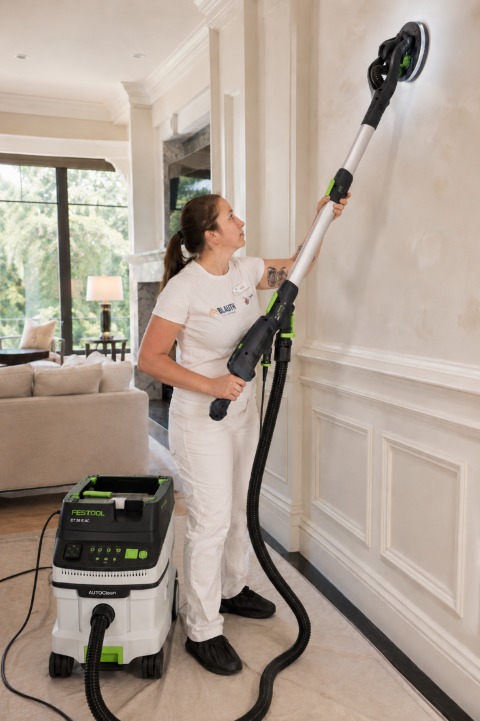
Before paint is ever applied, walls are sanded using HEPA dust-extraction systems to remove contaminants and improve surface uniformity while minimizing airborne dust. Surfaces are inspected under dedicated task lighting to reveal defects that standard room lighting frequently conceals, allowing repairs to be identified and addressed before they become visible through the finish coats.
Surrounding areas are carefully protected, roller covers are prepared before use to reduce lint contamination, and application methods follow established procedures developed through experience rather than personal improvisation. Even tasks that many contractors consider routine, such as cutting along ceilings, trim, and adjacent walls, are performed using dedicated lighting systems to improve visibility and maximize line quality.
None of these procedures are particularly glamorous, and most clients will never witness them firsthand. Nevertheless, they play a significant role in determining how the finished project ultimately looks and feels.
Professional Painting Is a System
The painting industry often focuses heavily on products. Paint brands, product lines, sheen levels, and color selections all receive considerable attention, and understandably so. However, products alone rarely determine the quality of a finished project.
The reality is that exceptional results are usually the product of disciplined execution rather than exceptional materials. A repeatable process reduces mistakes, improves consistency, and ensures that quality does not depend on luck, mood, or which individual happens to be holding the brush on a particular day.
For this reason, the most reliable indicator of a painting company’s quality is not the paint it uses, but the system it follows. Because in professional painting, the goal is not simply to make a room look good once. The goal is to make sure it looks good every single time.